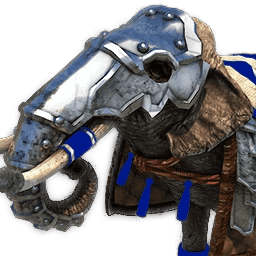
Elefante Blindado
Anti-building Siege Cavalry. Resistant to most ranged attacks.
Coste


Combate
Entrega
Valores base antes de tecnologías y mejoras; en una partida avanzada suelen ser mayores.
Línea de evolución
- Elefante Blindadode los Castillos
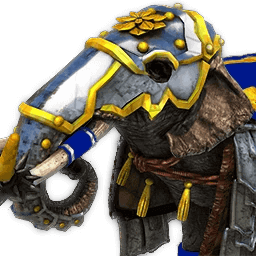
- Elefante de AsedioImperial
Sin datos de counters todavía
Aún no tenemos matchup registrados para Elefante Blindado. En el navegador de counters puedes ver de qué es fuerte y de qué débil cada unidad del juego.
Explorar todos los countersConocimiento
Bonificaciones de ataque
Clases de armadura
Determina qué bonificaciones de ataque le afectan.
Civilizaciones
Disponible en 4 civilizaciones.
Tácticas
In-game, the Armored and Siege Elephants are considered cavalry with attack bonus vs. buildings, not siege weapons. This has many implications, which changes the way the unit is used. They cost food instead of wood, which has advantages and disadvantages. It makes it harder to save up food for Age ups and military units. The effective food gathering rate from Farms is slower than the effective gather rate of wood of lumberjacks from trees, though Wheelbarrow and Hand Cart make the difference significantly less. Wood has several disadvantages in the late game, as trees can run out, leading to players venturing into more dangerous, forward forests for wood. Lumberjacks are generally harder to defend, as they are more often further from the Town Center, and lumberjacks tend to be closer together, making them more vulnerable to attacks. Also, Farms do not need as much micro to ensure the Villagers continue to gather efficiently. All these effects generally make Armored Elephants worse than the Battering Ram line units in the early game and better in the late game. Rams can garrison archer and infantry units for their protection. Garrisoned infantry units increase the speed of rams by 0.05 tiles/s/unit, taking them from 0.6 tiles/s to 0.9 tiles/s, the same as a Militia without Squires. Armored Elephants, on the other hand, are capped at 0.66 tiles/s. Infantry units also provide +10 attack vs. buildings to rams. Battering Rams have +150 attack vs. buildings, while Armored Elephants have +90 attack vs. buildings. Rams are repaired by Villagers, but Armored Elephants are healed by Monks. Besides being free, healing by Monks can be done from a safety of 4 tiles away. It also has a convenience factor of not having to bring a Villager to the front line and risk losing it. This mechanic is especially useful on Arena, where Monk-siege pushes are very common. Armored Elephants can heal when garrisoned inside a Castle (and in allied Kreposts), whereas Battering Rams cannot garrison inside any building once they are created. Herbal Medicine also affects healing rate when garrisoned inside a Castle. Armored Elephants only have one unit upgrade in the Siege Elephant, compared to the Battering Ram having two. This upgrade is more expensive and takes slightly longer than the upgrade for the Capped Ram, but is cheaper and faster than the Siege Ram, and thus much cheaper and faster than both of them combined. Battering Rams have armor, making them take extra damage from melee units, and are especially weak to low-melee attack units like Chu Ko Nu, Scorpions, Kipchaks, Fire Galleys, and Villagers. Armored Elephants have armor, which increases by 2 or 3 by cavalry armor technologies at the Blacksmith, thus negating these low-melee attack units as counters. Monks do not need Redemption to convert Armored Elephants, since they are organic siege units. They do, however, need to be in the proximity of the Armored Elephant. This may be dangerous, as non-Bengali Monks have no armor to resist the low melee attack of the Elephant. Still, it is unlikely for an Armored Elephant to kill a Monk with Sanctity before being converted, as they would require at least 6 hits to kill the Monk. The difference in pierce armor only matters against Trebuchets. Armored Elephants take bonus damage from anti-cavalry and anti-elephant units, some of which is reduced. Armored Elephants attack every 3 seconds, while rams attack every 5 seconds. This means that Armored Elephants have almost 66% better damage output than shown (before taking armor into consideration). Armored Elephants also target non-siege weapons on their own, while rams do not. If Armored Elephants are not micro-managed, they may chase other, faster units, or fight units they are not effective against. Rams, on the other hand, do not have this problem, and thus require less attention when given an attack command. === Naval warfare === One major case where Armored Elephants are generally much, much better is for the tactic of using either unit to tank damage from ships on water maps to protect the player's own ships. This is for multiple reasons. Wood is much more likely to run out on a water map and is a much more important resource. Un-upgraded Armored Elephants have 0.837 hit points/unit resource while un-upgraded Battering Rams have 0.744 hit points/unit resource. This makes Armored Elephants 12.43% better. The downside of having more land units with attack bonuses versus Armored Elephants is virtually irrelevant. Armored Elephants deal much more damage to ships than Battering Rams, which usually have no melee armor, as they have a higher melee attack and a higher Rate of Fire. This will not make them good against ships on their own, but it means they can aid in the fight when the enemy ships get next to shore while doing their usual role of tanking ship attacks. The only major downside of Armored Elephants over the Battering Ram line units for tanking damage from ships is that the Capped Ram and Siege Ram upgrades give increased , and many ships have an attack bonus versus rams (though it is not enough to make the tactic of using them to tank damage ineffective). However, this does not matter when both units have no unit upgrades, and this is unlikely to make up for the Armored Elephant's many strengths in this situation. Several civilizations have traits which make this strategy better as well. The Bengali Armored Elephants take less bonus damage from ships and attack faster with Paiks, which is especially relevant for Siege Elephants. The Dravidians can research Medical Corps, which makes them regenerate hit points. The Gurjaras have them train faster and can can make their food cost cheaper with Kshatriyas. The Bengali bonus of less bonus damage is probably the most relevant, as it is significant to the tactic and does not require a technology, making it work for when one or a few Armored Elephants are added into the army composition for the role. === Similarities === Both units cost almost the same amount of total resources (215 for Armored Elephants vs. 235 for Rams), benefit from Siege Engineers, and train in the exact same time. Armored Elephants with Bloodlines have the same hit points as Capped Rams. Despite having slightly different counters, they share weaknesses in Mangudai, Huszars, Eagle Warriors, Mangonels, heavy cavalry, and heavy infantry. Despite being usable against regular units, Armored Elephants prioritize attacking buildings, just like rams. Armored Elephants do not have any blast radius, just like Battering Rams. Both units also cannot be converted from a distance by enemy Monks, requiring them to get right next to the Armored Elephant/Battering Ram to start the conversion process. === Comparison table === { Units Cost Hit points Melee attack Attack speed Armor -3/180 -2/140+2 Attack vs buildings +150 +90 Attack vs siege +40 +25 Speed 0.6 Armor classes (+7) (+17) }
Consejos
- Commander, the Armored Elephant is a living battering ram. With +90 bonus vs buildings, it demolishes structures faster than any siege weapon. At 180 HP and 140 pierce armor, it tanks arrow fire indefinitely. Use Armored Elephants to break through fortified positions. They're slow at 0.6 speed but unstoppable against buildings.aoecoach
- -2 melee armor means cavalry and infantry shred you. Monks also convert you easily. Need support.aoecoach